
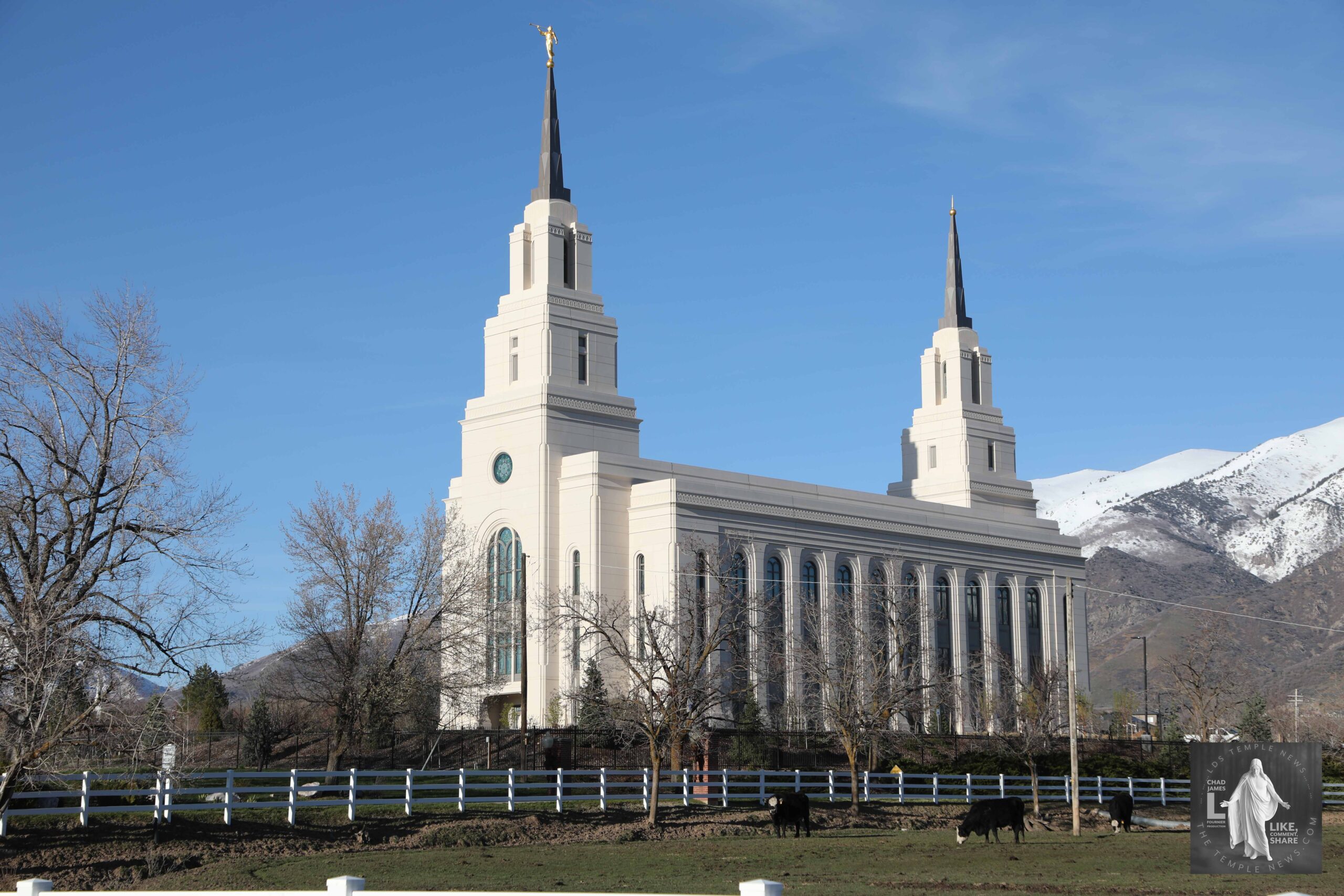
The Layton Utah Temple is the 195th dedicated temple in operation for The Church of Jesus Christ of Latter-day Saints. Located in Davis County, it is the twenty-second temple completed in Utah and the second in the county, following the Bountiful Utah Temple. Its architecture draws on the area’s agricultural heritage and the flowing forms of European Art Nouveau.
Location, history, and key facts
Address: 1400 Oak Hills Dr, Layton, Utah 84040
Property: 11.8 acres
Interior area: 93,539 square feet
Height: 215 feet to the west tower, including the Angel Moroni statue
Elevation: 4,468 feet
Exterior finish: Precast concrete panels
Interior rooms: Four instruction rooms, six sealing rooms, and one baptistry
President Russell M. Nelson announced the Layton Utah Temple on April 1, 2018, during the 188th General Conference. A public rendering was released October 8, 2019. The groundbreaking was held May 23, 2020, under the direction of Craig C. Christensen.
The groundbreaking had first been scheduled for May 30, 2020. Because of the COVID-19 pandemic and the need to limit public gatherings, Church leaders decided that a traditional event with invited guests was not prudent. The First Presidency assigned the Utah Area Presidency to hold a small-scale groundbreaking a week earlier so construction could proceed. Church spokesperson Irene Caso shared that explanation in a statement issued later that day.
The public open house ran from April 19 through June 1, 2024, excluding Sundays. Apostle David A. Bednar dedicated the temple on June 16, 2024.
Architectural character
Inspired by traditional Latter-day Saint and other religious architecture, the Layton Temple incorporates design motifs shaped by Layton City’s agricultural heritage and the European Art Nouveau movement, sometimes called Secessionism Architecture. That style is known for organic shapes, floral and foliage motifs, and curving lines. Throughout the House of the Lord, abstracted seedlings, fruit blossoms, and leafy fruit trees express the area’s agrarian roots in an Art Nouveau style. Related abstractions appear in the exterior friezes. Cascading arched windows soften the temple’s rectilinear form.
The architectural design features two attached end spires and a gold-leafed Angel Moroni statue. The precast concrete exterior and its sweeping windows give the House of the Lord a distinctive profile.
Grounds and exterior details
More than 400 shade, flowering, and evergreen trees, along with thousands of shrubs and perennials, enrich the grounds. A granite fountain sends water cascading down its surface. At the west end, plaza pavers echo patterns found in the large entry windows.
The art-glass windows on the exterior depict a seedling growing into a fruit tree. The plant imagery carries through the design, linking the surrounding landscape with details inside the House of the Lord.
Interior materials and craftsmanship
The interior reflects the same natural themes through seedlings, cherry blossoms, and leafy branches. Millwork details draw on fruit-tree blossoms and leaves and appear in pilasters, recommend desks, pew end panels, and altars. Organic curves inform the light fixtures and decorative painting. As one moves upward between floors, the designs in the art glass, lighting, flooring, and millwork become more intricate.
Interior art glass relates to the exterior designs, with stylized seedlings, blossoms, and leafy fruit-tree branches. The interior glass uses a simplified etched treatment rather than colored glass.
At the entrance to the second-floor patron waiting area is an antique Tiffany Studio Window, circa 1915, titled “The Resurrection.” The window was purchased from a United Presbyterian Church in Amenia, New York, before that church was demolished in 2015.
Carpeting throughout the temple was manufactured in the United States. The broadloom nylon selections use varied cream, gold, and green tones. Several sealing rooms and the celestial room feature decorative carving. Custom area rugs in the entries, baptistry, and bride’s room reflect Art Nouveau, with vibrant colors and stylized organic flowers and foliage that echo motifs found throughout the temple.
Stone quarried in Turkey and milled in China is used in higher-traffic areas, including the entries, baptistry, and grand staircase. The principal colors are Burder Grey and Burder Blanco, with a stone-tile leaf pattern in shades of green.
Decorative painting throughout the temple follows the overall design balance. Gold and beige floral patterns accent the walls of the various ordinance rooms. Ceilings feature floral patterns and curving lines, with gold-leafed molding around the chandeliers.
Dark African Anigre wood, stained medium brown, appears in paneling, coffered ceilings, and trim. Doors are stained to match, and decorative carvings enhance casings above doors leading to ordinance spaces. Custom-designed bronze hardware and railings continue the temple’s motifs.
Decorative lights and chandeliers take inspiration from antique Art Nouveau fixtures and the temple’s agricultural motifs. Their design complements the surrounding materials and details. In the ordinance rooms, the fixtures provide warm, bright light that supports the reverent and uplifting character of these spaces.
Selected works of art
The Layton Utah Temple includes original works made specifically for the temple as well as older pieces selected for their fit with its setting and design:
- “Zion’s Mount” — Josh Clare, living artist, Utah
- “Layton Morning” — David Dibble, living artist, Utah
- “Layton Evening” — David Dibble
- “Ascension of Christ” — Michael Malm, living artist, Utah
- “Beside the Creek” — Ken Stockton, living artist, Arizona
- “Mountains In Winter – Farmington Utah” — LeConte Stewart (1891–1990), Utah
- “Winter in Liberty” — LeConte Stewart
A lasting expression of Layton
From the fruit-tree imagery and arched windows to the landscape, art glass, stone, wood, and custom metalwork, the Layton Utah Temple brings local agricultural references together with Art Nouveau design. Its history, craftsmanship, and carefully coordinated details make it a distinctive House of the Lord in Davis County.
Layton utah Temple Glory to the Highest