
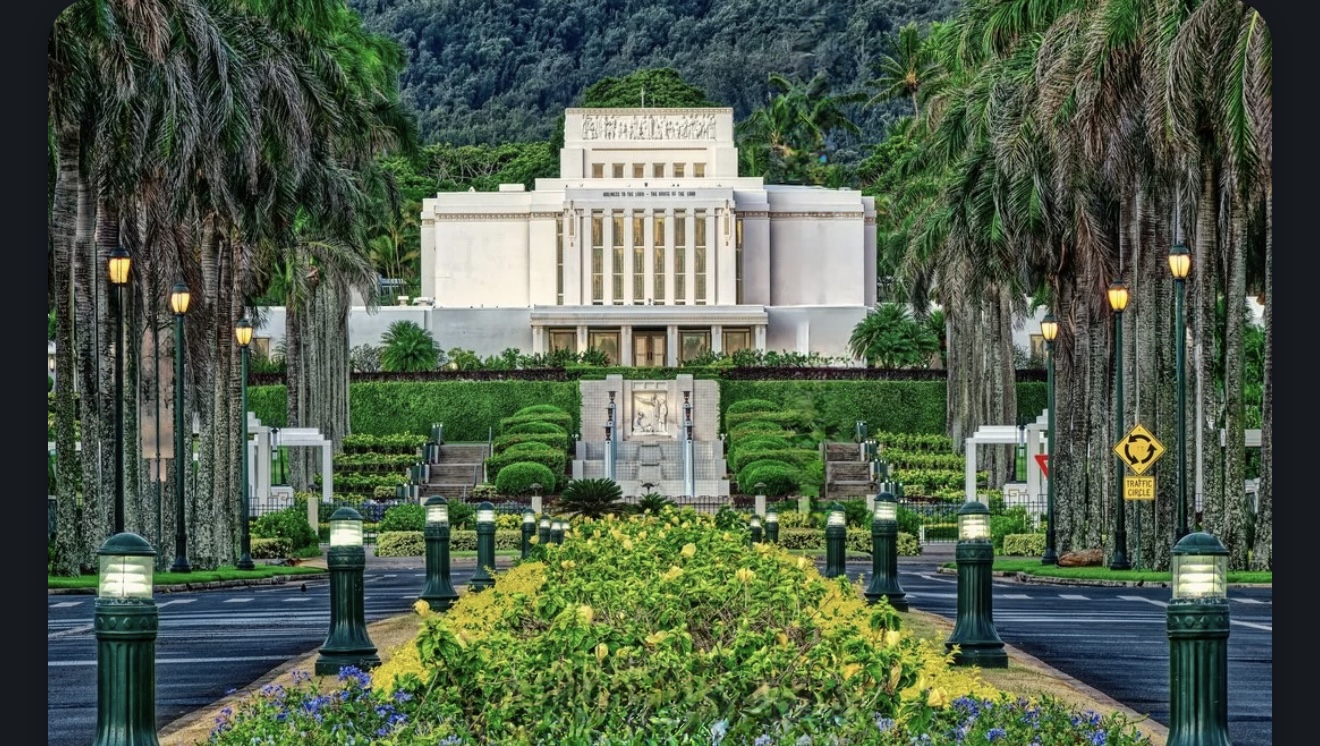
The Laie Hawaii Temple stands as a remarkable testament to faith, beauty, and architectural innovation, situated on the stunning north shore of Oahu. Officially announced on October 3, 1915, and with groundbreaking ceremonies held on February 8, 1916, this temple is the fifth constructed by The Church of Jesus Christ of Latter-day Saints, setting a significant precedent for the Church’s commitment to serving communities beyond the continental United States.
Prime Location and Striking Architecture
Elevated on a gentle hill and enveloped by the lush, vibrant flora of Hawaii, the Laie Hawaii Temple is strategically located approximately half a mile from the Pacific Ocean. The sprawling site covers 11.4 acres and is easily accessible via Hale Laa Boulevard, an impressive thoroughfare lined with tropical gardens, palm trees, and decorative lights, which welcomes visitors from Kamehameha Highway. Measuring 42,100 square feet and rising to a height of 50 feet, the temple’s architectural design is both breathtaking and distinctive, characterized by a singular central tower capped with a flat roof.
The external façade is crafted from an exquisite blend of concrete, crushed lava, and coral, reinforced with steel to achieve a light cream finish that seamlessly integrates with the island’s natural beauty. Integral to its design, the temple features intricately carved friezes by sculptor Avard Fairbanks, symbolizing the four dispensations of time: the Old Testament (west), New Testament (south), Book of Mormon (north), and the Latter-day Dispensation (east).
Comprehensive Interior Facilities
Inside, the Laie Hawaii Temple is designed to meet the diverse spiritual needs of its patrons. It includes four instruction rooms, five sealing rooms, and one baptistry, offering a full range of sacred ordinances. Originally, the presentation of the endowment was delivered via live acting, creating a deeply immersive experience for all participants.
The temple has undergone significant renovations to enhance patron experience. Closing in May 1976 for extensive remodeling, it featured a new front entrance and enlarged facilities, transitioning the ordinance rooms to stationary spaces equipped for cinematic presentations. More recently, the temple closed in December 2008 for crucial structural and seismic upgrades, restoring the ordinance rooms to their original progressive-style presentation, with advanced video technology.
Historical Significance and Achievements
The Laie Hawaii Temple holds a distinguished place in history as the first temple constructed in the Hawaii Territory and the first to be dedicated outside the mainland United States. Built on the historically significant Laie Plantation — a 6,000-acre parcel purchased for $14,000 in 1865 — the temple’s site was dedicated after President Joseph F. Smith felt a divine inspiration during a visit to Hawaii in the spring of 1915, a decision that received public support during the October 1915 General Conference.
The construction of the temple faced challenges, notably a lumber shortage that brought work to a halt. However, after fervent prayers for assistance, a stranded freighter was discovered nearby, providing the necessary lumber, ensuring the completion of this sacred structure.
Milestones and Community Impact
The Laie Hawaii Temple has marked numerous significant milestones since its dedication. Officially dedicated from November 27 to 30, 1919, by President Heber J. Grant, the temple has undergone various renovations, including a major update from May 2 to May 27, 1978, followed by a rededication by Spencer W. Kimball from June 13 to 15, 1978. The temple has continuously served the community, with public open houses such as the notable event from October 22 to November 13, 2010, culminating in its last rededication led by President Thomas S. Monson on November 21, 2010.
The Laie Hawaii Temple also serves as a vital cultural and educational hub, located adjacent to Brigham Young University–Hawaii, which draws students from diverse backgrounds. The nearby Polynesian Cultural Center stands as Hawaii’s number-one paid attraction, further underscoring the temple’s integration into the local community and its role in promoting the rich cultural heritage of the Hawaiian Islands.
In summary, the Laie Hawaii Temple is not merely a place of worship; it is a powerful symbol of faith, history, and community. It continues to inspire both locals and visitors, embodying an exceptional synthesis of spirituality and artistry that reflects the profound connections of the Church within the Pacific region.