
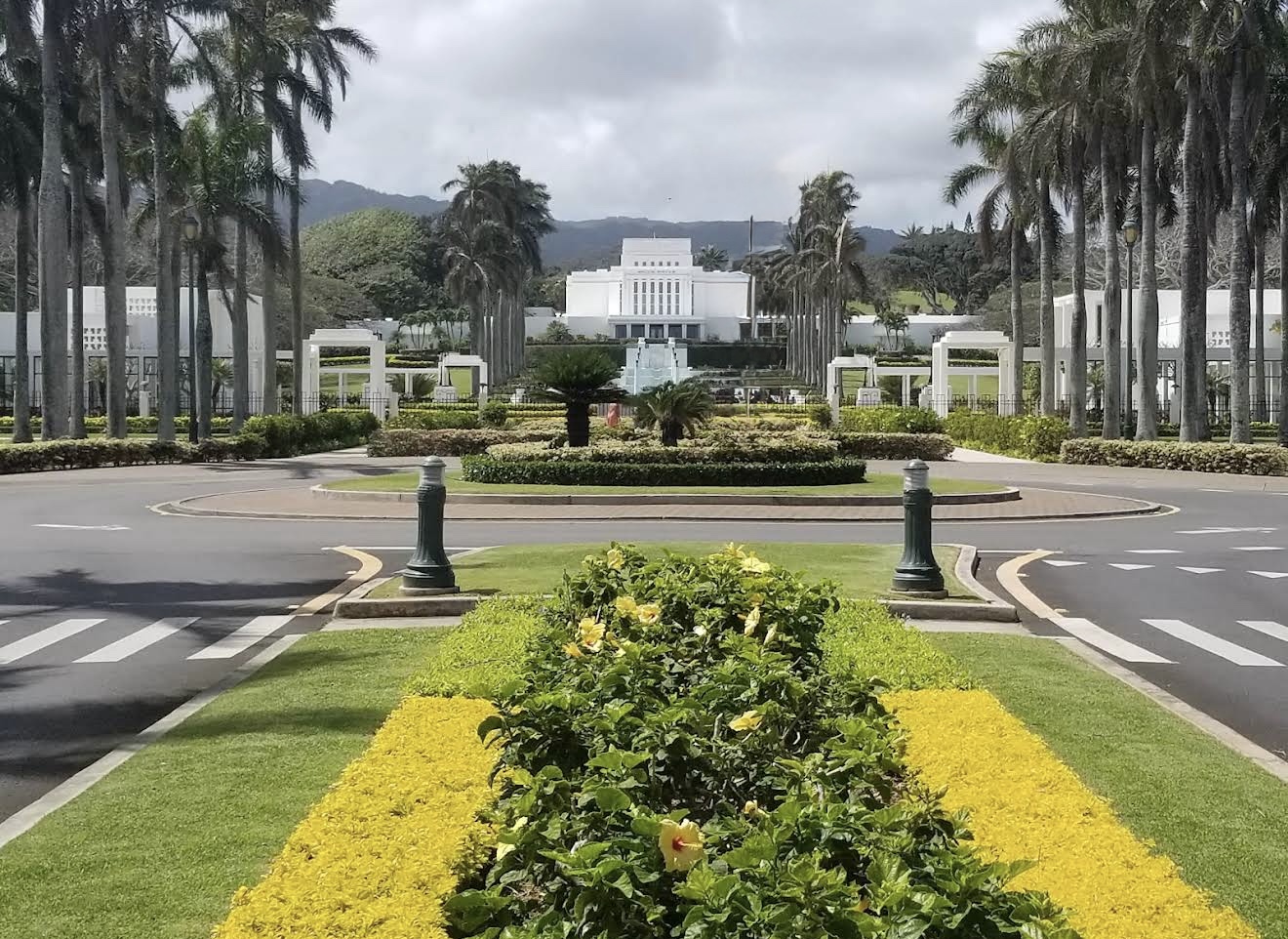
The Laie Hawaii Temple stands as a stunning architectural marvel and a significant spiritual landmark on the north shore of Oahu. Announced on October 3, 1915, the temple marked a pivotal moment in the history of The Church of Jesus Christ of Latter-day Saints, becoming the first temple built in the Pacific islands and the fifth overall. The groundbreaking took place on February 8, 1916, setting in motion the construction of a sacred space that would serve countless individuals and families.
**Location and Architecture**
Strategically located on a picturesque hill just half a mile from the Pacific Ocean, the Laie Hawaii Temple enhances its surroundings with breathtaking beauty and serenity. Covering 11.4 acres, it is easily accessible via Hale Laa Boulevard, a striking entrance lined with tropical gardens and palm trees, inviting visitors to experience its spiritual ambiance. The temple’s impressive size of 42,100 square feet and a height of 50 feet make it a prominent feature in the local landscape, with its elevation standing at 29 feet.
The exterior is masterfully constructed from concrete blended with crushed lava and coral, reinforced with steel to achieve a sophisticated white cream finish that complements the natural Hawaiian scenery. Architecturally, the temple boasts a single central tower topped with a flat roof, creating a distinctive silhouette. The artistic elements include intricately carved friezes by renowned sculptor Avard Fairbanks, depicting the four dispensations of time: the Old Testament (west), New Testament (south), Book of Mormon (north), and Latter-day Dispensation (east).
**Interior Features and Facilities**
Inside, the Laie Hawaii Temple is designed to fulfill the diverse spiritual needs of the community it serves. It features four instruction rooms, five sealing rooms, and a baptistry, providing a full spectrum of sacred ordinances. The original delivery of the endowment was made engaging through live acting, creating a rich experience for participants.
The temple has not only preserved its historical integrity but has also adapted through thoughtful renovations. In May 1976, it closed for extensive remodeling that included a new front entrance and expanded patron facilities. This renovation transitioned the ordinance rooms to a more modern stationary presentation, enhancing the overall experience for attendees. A subsequent closure in December 2008 was undertaken for vital structural and seismic improvements, restoring the ordinance rooms to their original progressive-style format while integrating modern video technology.
**Historical Significance**
The Laie Hawaii Temple is a landmark of historical significance, being the first temple built in the Hawaii Territory and the first dedicated outside the mainland United States. It sits on historically significant land known as Laie Plantation, a 6,000-acre parcel acquired in 1865 for $14,000. Driven by divine inspiration, President Joseph F. Smith dedicated the site during a visit to Hawaii in the spring of 1915, an act that was publicly sustained at the October 1915 General Conference.
Construction faced challenges, including a critical shortage of lumber that temporarily halted progress. However, through prayer and faith, assistance arrived when a freighter was found stranded nearby, providing the necessary lumber to continue and complete the temple.
**Renovations and Celebrations**
The Laie Hawaii Temple has celebrated numerous milestones throughout its history. The formal dedication occurred from November 27 to 30, 1919, presided over by President Heber J. Grant. The temple underwent major renovations in 1978 and was rededicated by President Spencer W. Kimball from June 13 to 15 of that year. It has held multiple public open houses, most notably from October 22 to November 13, 2010, leading to its last rededication by President Thomas S. Monson on November 21, 2010.
**Cultural and Community Influence**
Beyond its spiritual mission, the Laie Hawaii Temple functions as a cultural and educational epicenter, positioned alongside Brigham Young University–Hawaii, which welcomes students from diverse backgrounds and influences. The nearby Polynesian Cultural Center stands as Hawaii’s premier paid attraction, further showcasing the temple’s integral role within the community and its commitment to celebrating the rich cultural heritage of the Hawaiian Islands.
The Laie Hawaii Temple remains a beacon of faith, inspiration, and beauty. It reflects the deep-rooted connections of the Church within the Pacific region, serving as a transformative space for individuals and families and leaving an indelible mark on the lives it touches.