
The Unique Moments of Alabang Philippines Temple
The Alabang Philippines Temple is the 213th dedicated temple in operation. Located in Filinvest City, Alabang, it reflects elements of the Philippines’ cultural heritage in its design, including the sampaguita, the country’s national flower.
Location and History
The address is #5 Filinvest Ave, Filinvest City, Alabang, Muntinlupa City, 1781 Metro Manila, Philippines. The House of the Lord stands at the corner of Filinvest Avenue and Corporate Avenue.
The temple was announced to the public by Prophet Thomas S. Monson at General Conference on April 2, 2017. Its rendering was released on February 12, 2020.
The groundbreaking and dedication of the chosen ground took place on June 4, 2020, led by Elder Evan A. Schmutz. He said, “We dedicate this chosen ground for the construction of the Alabang Philippines Temple as a house of holiness, a house to be built in Thy Son’s name wherein the important work of salvation may be done.”
The groundbreaking event had originally been scheduled for Saturday, May 2, 2020, with Elder D. Todd Christofferson of the Quorum of the Twelve Apostles presiding. Because of local restrictions imposed in response to the COVID-19 pandemic, the Philippines Area Presidency was assigned to preside over the event a month later.
A public open house was held from November 21 through December 13, 2025. Apostle David A. Bednar dedicated the temple on January 18, 2026.
Place in Philippine Temple History
The Alabang Philippines Temple was the fourth temple built in the Philippines and the third in Luzon, following the Manila Philippines Temple, dedicated in 1984, and the Urdaneta Philippines Temple, dedicated in 2024. It was announced in the 33rd anniversary year of the Manila Philippines Temple.
It was also the second temple built outside the United States in the same metropolitan area as another operating temple. With the Alabang and Manila temples, the Greater Manila Area became the second metropolitan area outside the United States with more than one temple, following the Lima metropolitan area in Peru.
Size and Architectural Features
The temple is built on 2.62 acres and has an area of 35,998 square feet. It is a one-story temple, stands 175 feet high, and sits at an elevation of 57 feet. Its exterior finish is White Oro Cristal granite.
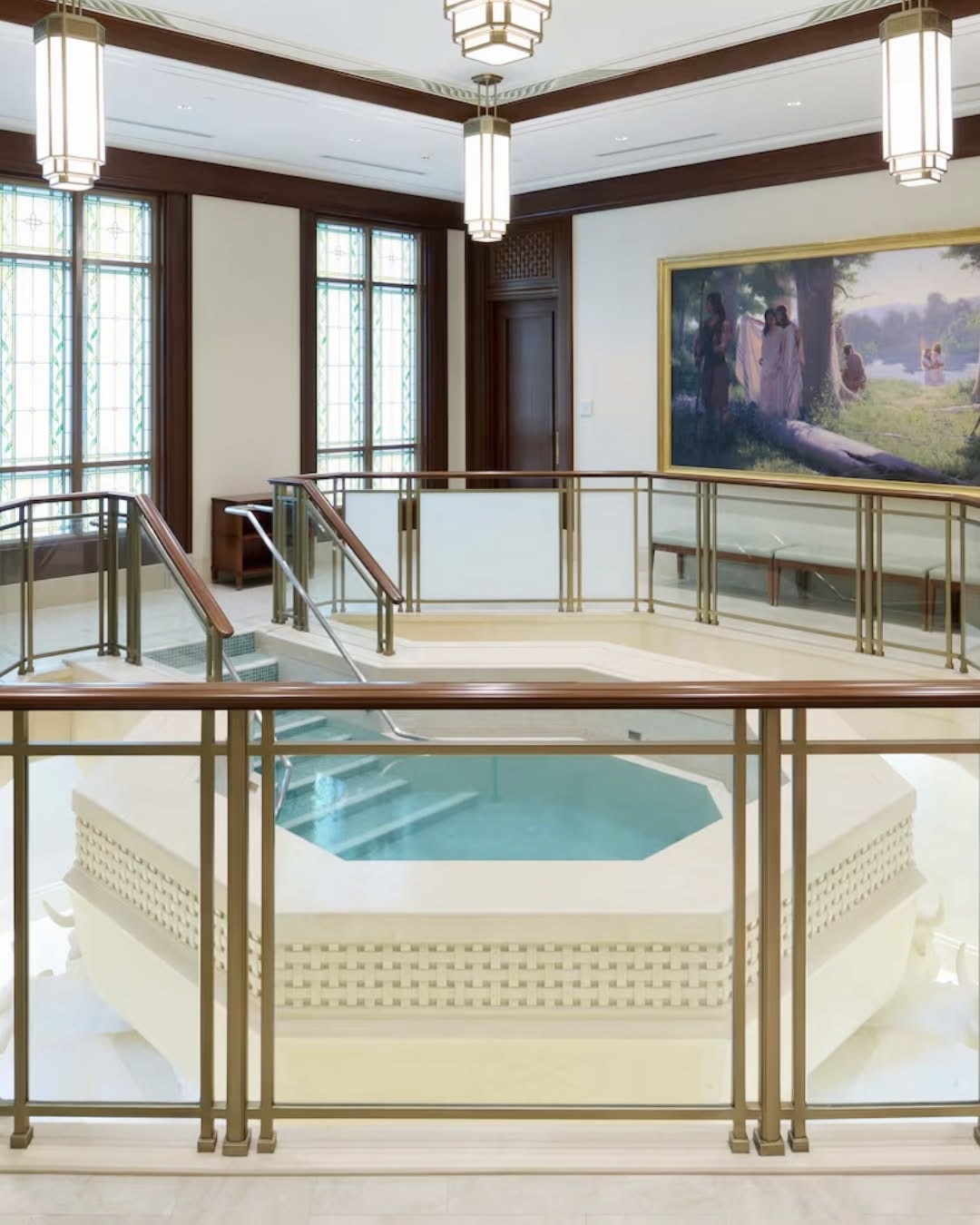
The architecture includes a single attached end spire and no gold-leafed Angel Moroni statue. The temple has four instruction rooms, three sealing rooms, and one baptistry.
The exterior doors are made of art glass featuring a representation of the sampaguita. The glass uses cream, amber, white, green, and pink. Around the baptismal font, the railings are made of powder-coated steel. The perimeter fence is also powder-coated steel.
Interior Finishes and Furnishings
Interior art glass is paired with Khaya, or African mahogany, hardwood and bronze hardware. The interior doors are made of Khaya hardwood, with bronze hardware and integrated art glass panels. The interior door hardware is brass.
The interior light fixtures are Decorative Lighting, made with crystal, acrylic, and brass. The interior area rugs are 100% wool and were fabricated by Tai Ping Carpets in Hong Kong, China. The carpet is nylon, and the ceilings combine gypsum board painted Antique White with suspended acoustic ceiling tiles.
Interior floral arrangements are Permaflora, and the furniture brand is Theodore Alexander. Millwork is made from solid Khaya hardwood and veneers, stained and painted. Interior stone is Honey Gold limestone from China.
Art, Color, and Grounds
Original artwork in the temple includes “Valley Stream” by Keith Bond, “Mount Pico de Loro” by Michael Coleman, and “Balagbag Falls” by Kimbal Warren. The supplied details do not specify a maker or medium for the temple’s art painting.
The general interior paint color is Bone Ivory, with Cyprus Spring trim. Decorative paint colors are Alexandra Peach, First Lady, a darker peach; Lucky Day, a muted green; and Vapor, a taupe.
The grounds include 90 trees representing 10 species, including Manila palm, royal palm, banaba, takulao, katmon, botong, champaca, and kalachuchi. Planting also includes 32 different species of tall, medium, and low shrubs and ground covers, many of them flowering perennial plants.