
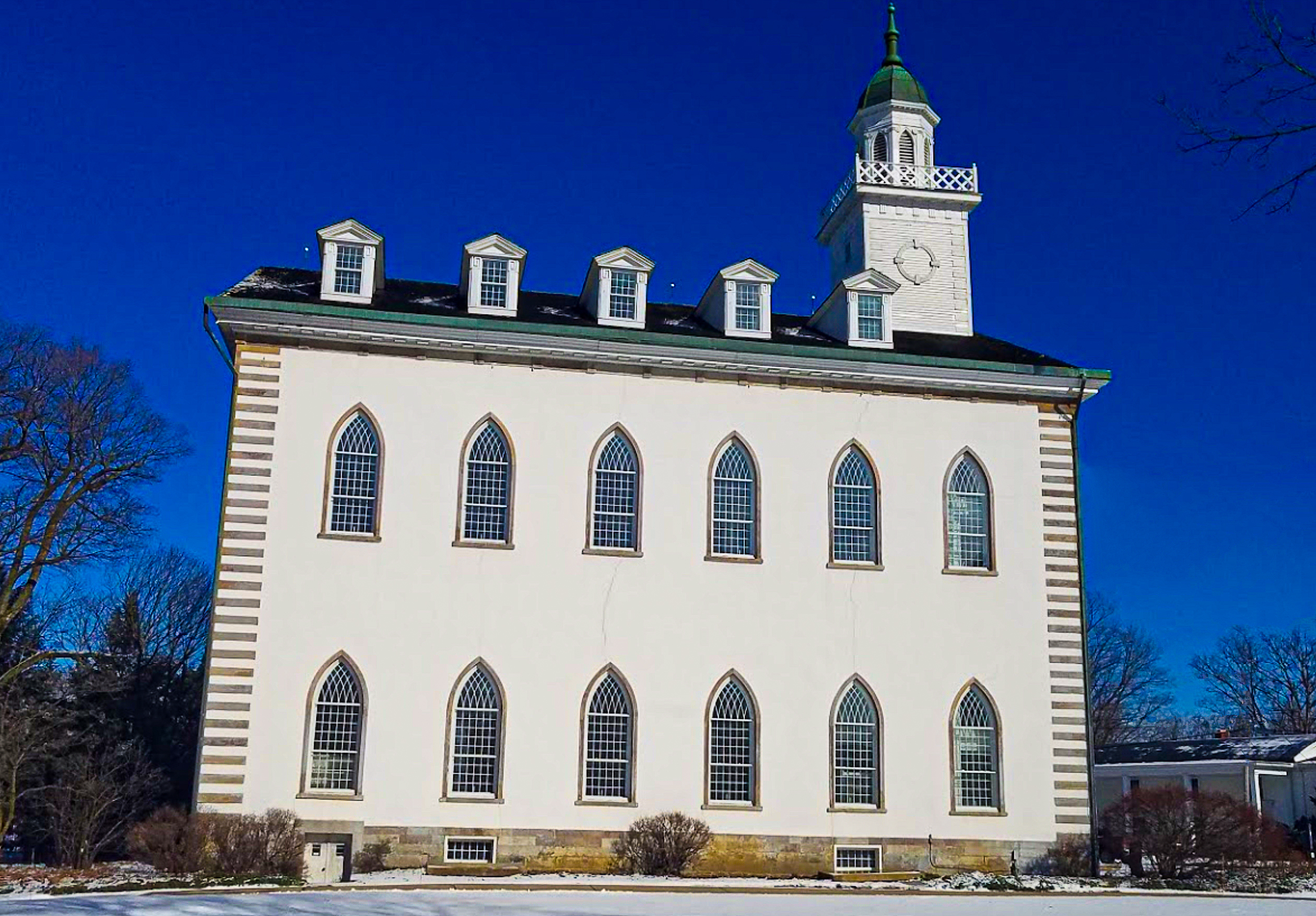
Kirtland Temple media by LDS Temple News
Nestled on a bluff in northeastern Ohio, approximately 25 miles east of Cleveland, the Kirtland Temple is a significant historical site that tells a rich narrative of faith and early American religious history. Its address is 9020 Chillicothe Road, Kirtland, Ohio 44094.
The Inception of the Kirtland Temple
The history of the Kirtland Temple can be traced back to December 27, 1832, when the Lord instructed the Saints to establish a house of God, as mentioned in Doctrine and Covenants 88:119. This important instruction was followed by a revelation on June 1, 1833, which conveyed the design of the Temple and chastised the Saints for their failure to commence construction.
Construction of the Kirtland Temple began on June 6, 1833. During this tumultuous period, the site required protection from hostile crowds, which necessitated nightly guards. The cornerstone was laid on July 23, 1833, presided over by Prophet Joseph Smith and Apostles Sidney Rigdon and Frederick G. Williams.
By the Fall of 1833, dedicated Church members built a sawmill on Stoney Brook to expedite the construction. After several years of labor, the Temple was finally dedicated on March 27, 1836, with around 1,000 attendees. Notable experiences during the dedication included visions and an overwhelming sense of divine presence, as recounted by Smith. He described a remarkable event when a sound akin to a mighty wind filled the space, culminating in an extraordinary atmosphere of awe and reverence. This historical dedication lasted a remarkable seven hours.
Sacred Occurrences in the Kirtland Temple
Easter Sunday, April 3, 1836, marked another pivotal moment in the Temple’s history. On this day, during the Jewish Passover, the Lord accepted His house, appearing to both Joseph Smith and Oliver Cowdery. Doctrine and Covenants Section 110 documents the restoration of priesthood keys through ancient prophets, signifying a monumental shift in Church history. The ordinances received within these walls were seen as only a partial endowment, with a greater manifestation expected in later years.
However, this period of vitality was short-lived. By 1838, many of the Saints had moved away from Kirtland, leading to varying uses of the Temple, including private gatherings and educational purposes. The Temple was later leased to serve as a public school.
Restoration and Preservation
In 1880, the Community of Christ, formerly known as the Reorganized Church of Jesus Christ of Latter-day Saints, reestablished ownership, committing to restoring the Kirtland Temple to its original design. For 144 years, this care allowed the Temple to stand as a testament to its heritage.
On March 5, 2024, the ownership transitioned to The Church of Jesus Christ of Latter-day Saints for an agreed-upon amount. Preparations for its reopening to the public began shortly afterward, with a reopening date set for March 25, 2024, after a brief closure for updates.
Architectural Highlights
The Kirtland Temple covers an impressive 15,000 square feet, standing at a height of 110.5 feet and perched at an elevation of 765 feet. This three-story complex is set on 5.8 acres and showcases a blend of Federal, Greek Revival, and Gothic Revival architectural styles. Notably, the exterior is finished with sandstone stucco, emphasizing the beauty of its design.
The Temple’s large steeple and cupola are key features, and the original finial atop the cupola is preserved within the accompanying Visitor Center. Its distinctive olive green twin entry doors framed by stone quoins serve as a notable element of the Temple’s exterior. Inside, simple, 19th-century New England meetinghouse designs prevail, relying on natural light and historical oil lamps for illumination.
Unique Details and On-Site Artefacts
While the Kirtland Temple does not feature traditional artwork or murals, it embodies architectural simplicity with two large assembly rooms and unique pulpits. The interior light fixtures are reflective of the 19th century, contributing to the authentic atmosphere.
The Temple is devoid of certain rooms typical in other houses of worship, including baptismal fonts and sealing rooms. The focus remains on the unique design received by Joseph Smith, with the halls equipped for both worship and education. Interestingly, the early Saints often referred to this notable place as the “Lord’s House,” reflecting the terminology of that period.
The Kirtland Temple serves not merely as a historical site, but as a rich record of faith, dedication, and divine interaction that follows the lives of early Saints in Ohio. It continues to draw interest from those wishing to understand the roots of their traditions and beliefs.