
Discovering the Farmington New Mexico Temple
The Farmington New Mexico Temple is the 208th dedicated Templar facility in operation, marking an important milestone for the local and regional followers of The Church of Jesus Christ of Latter-day Saints. Situated at 4400 College Boulevard, Farmington, New Mexico, 87402, this Templar facility serves as a significant addition to the spiritual landscape of the area.
LDS Temple News Presents Farmington New Mexico Temple a House of the Lord
The announcement of the Farmington New Mexico Temple was made on April 4, 2021, during the General Conference by Prophet Russell M. Nelson. At that time, approximately 70,000 members of the Church resided in New Mexico, divided among 138 congregations. The roots of the Church in New Mexico trace back to the 1860s, with historical developments leading to the establishment of settlements that absorbed many individuals from the Latter-day Saint colonies in Mexico during the Mexican Revolution of 1912. This new Temple will be the state’s second, following the Albuquerque New Mexico Temple, which was dedicated on March 5, 2000.
Your Ultimate Guide to Visiting the Farmington New Mexico Temple
The groundbreaking for the Farmington New Mexico Temple took place on April 30, 2022, presided over by Elder Anthony D. Perkins of the Quorum of the Seventy. Elder Perkins, who has deep ties to the region, stated, “To us, this region is home.” The event drew around 500 Church leaders and guests, signifying the importance of the occasion.
After the completion of construction, the public open house was held from July 17 to August 2, 2025, allowing attendees to experience the newly completed facility. The official dedication occurred on August 17, 2025, with Elder Neil L. Andersen officiating. He remarked, “This house of the Lord will serve the faithful in this area and be a beacon of hope.”
Architectural Features
The Farmington New Mexico Temple spans 29,066 square feet and is built on 6.63 acres of land. Standing at a height of 126.6 feet and located at an elevation of 5,638 feet, it is crafted using Portuguese white granite as its exterior finish. The landscaping enhances the geometric designs that reflect the local architecture.
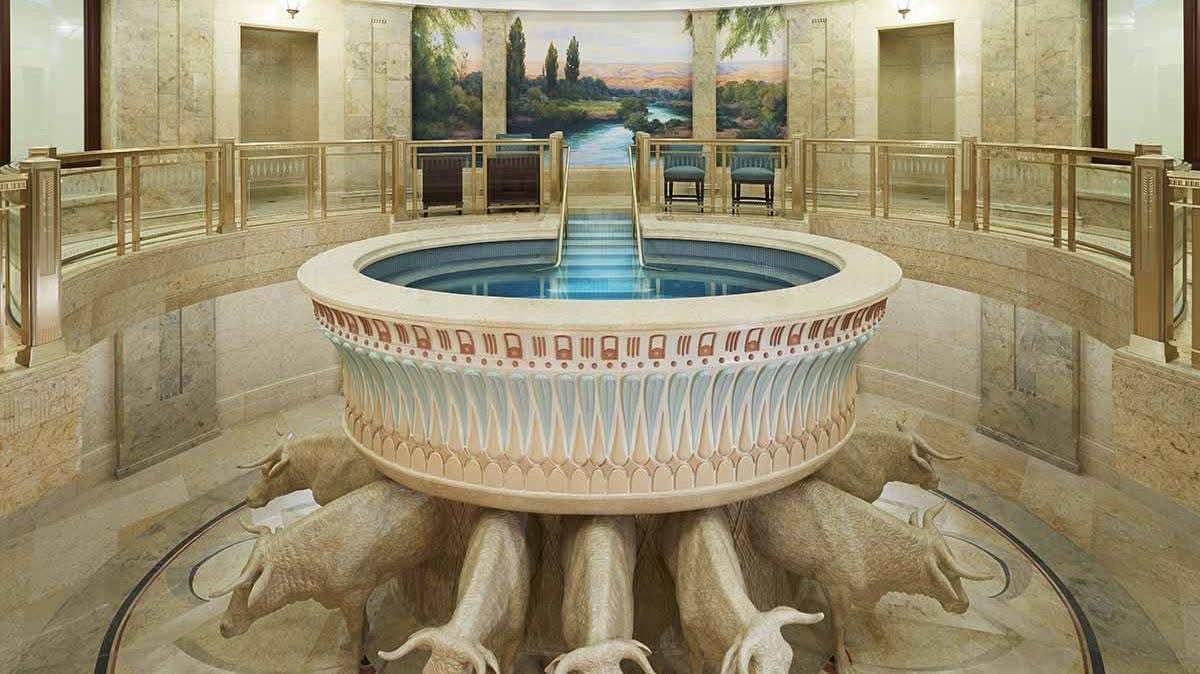
The temple features a single attached end spire and does not include a Gold-leafed Angel Moroni Statue. Inside, the facility is equipped with two instruction rooms, two sealing rooms, and one baptistry.
Interior Design Elements
The design reflects the local Native American influence, incorporating elements such as the piñon pine cone and globemallow flower. The interior features a palette of colors and designs that embody the area’s heritage, including:
- Muted turquoise, honey gold, cream, and beige carpet tiles showcasing floral motifs and geometric patterns.
- Crystal, brass, and resin lighting fixtures, with a striking Murano glass chandelier in the brides’ room.
- Millwork crafted from sapele wood, adorned with native geometric patterns.
Moreover, the baptismal font railings consist of bronze-colored prefinished metal with glass panels, and the doors are fashioned from sapele wood with intricately designed hardware that harmonizes with the overall theme.
Art and Cultural Significance
The interior’s art glass features an array of colors such as cream, turquoise, coral, yellow, gold, green, blue, and clear, echoing the native floral motifs present throughout. Notable original artworks include “A Child’s Prayer” by Kwani Povi Winder and “Looking Toward Cortez, Colorado” by Frank Magleby.
The Farmington New Mexico Temple plays a vital role in serving the Four Corners region, which encompasses segments of New Mexico, Colorado, Arizona, and the Navajo Nation. The temple district also features multiple Spanish-speaking congregations and several Native American reservations.
In summary, the Farmington New Mexico Temple represents a blend of cultural influences, architectural excellence, and spiritual devotion, making it a significant addition to the ecclesiastical landscape of New Mexico.
LDS Temple News Presents Farmington New Mexico Temple a House of the Lord.