
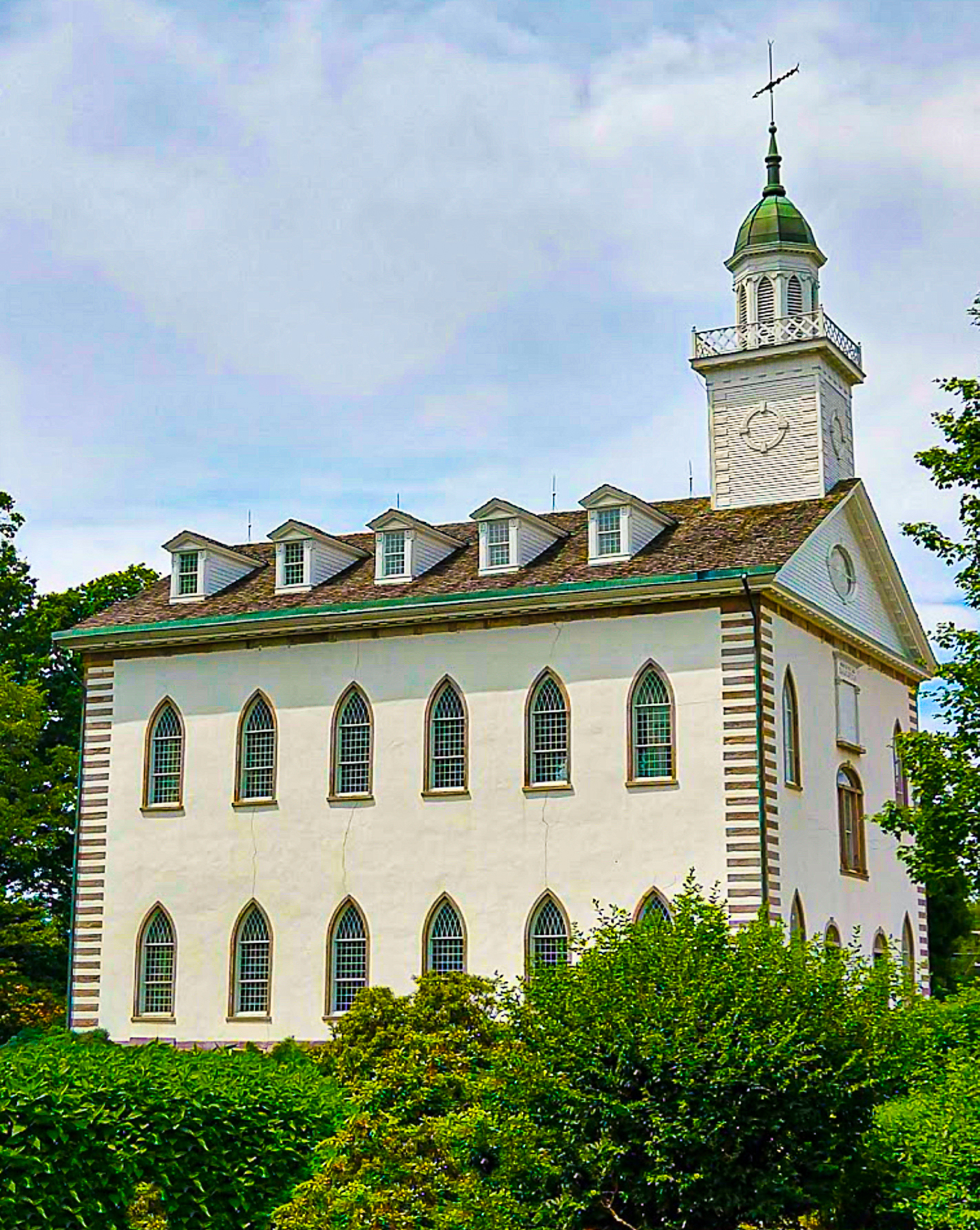
LDS Temple News Presents the Kirtland Temple
The Kirtland Temple, a significant site in the history of early Latter-day Saint faith, serves as a testament to the dedication and vision of its founders. Nestled atop a bluff in northeastern Ohio, approximately 25 miles east of Cleveland, the Kirtland Temple overlooks the picturesque Chagrin Valley. The temple is located at 9020 Chillicothe Road, Kirtland, Ohio 44094.
A Historical Journey
The Kirtland Temple’s origins can be traced back to December 27, 1832, when the Lord instructed the early Saints to establish a house of God, as detailed in Doctrine and Covenants 88:119. Announced to the public shortly thereafter, the temple’s design was revealed on June 1, 1833.
Construction officially commenced on June 6, 1833. During this time, the site faced challenges, including threats from mobs and vandals, necessitating its protection at night. On July 23, 1833, key leaders, including Prophet Joseph Smith, Apostle Sidney Rigdon, and Apostle Frederick G. Williams, participated in the cornerstone-laying event.
By the fall of 1833, the community took further steps to expedite construction by building a sawmill on Stoney Brook. The Kirtland Temple was dedicated on March 27, 1836, with an attendance of about 1,000 individuals. This dedication was marked by extraordinary experiences, including visions, prophecies, and angelic appearances, as described by Joseph Smith: “a noise was heard like the sound of a rushing mighty wind… the Temple was filled with angels.” The event lasted a remarkable seven hours and is recorded in Section 109 of the Doctrine and Covenants.
Subsequent Developments
On April 3, 1836, during the Jewish Passover, the Lord appeared to Joseph Smith and Oliver Cowdery in the Kirtland Temple, affirming its importance. The full record of this event can be found in Doctrine and Covenants Section 110, where priesthood keys were restored through ancient prophets such as Moses, Elias, and Elijah.
Despite its early significance, the Kirtland Temple saw a decline in attendance, and by 1838, many Saints left Kirtland, repurposing the building for various uses, including a public school for many years. In 1880, the Community of Christ reclaimed the Kirtland Temple and worked diligently to restore it closely to its original condition. This stewardship continued for 144 years.
On March 5, 2024, ownership transferred from Community of Christ to The Church of Jesus Christ of Latter-day Saints, preparing to reopen to public tours on March 25, 2024, after a 20-day closure for preparations.
Architectural Features
Constructed on 5.8 acres, the Kirtland Temple spans 15,000 square feet and rises to a height of 110.5 feet with three stories. Its architectural design exhibits a combination of Federal, Greek Revival, and Gothic Revival styles, with a notable steeple and cupola. The exterior features a sandstone finish accented by plaster, while the primary entry doors boast a vibrant olive green hue.
One impressive aspect of the Kirtland Temple is its historical elements. The intricate arched windows, crafted by Brigham Young and his brother Joseph, contribute to the building’s unique character. These features can also be seen at the Church History Museum on Temple Square. While traditional paintings and murals are absent from its interiors, the simplicity of the design allows for natural light to illuminate the space, with oil lamps providing additional illumination.
Interior Layout and Symbolism
The interior of the Kirtland Temple showcases two large wooden assembly rooms equipped with two-way pulpits and movable pews. Early Saints referred to this space simply as the “Lord’s House,” reflecting the terminology of their time, as the term Temple was not in widespread use.
While the Kirtland Temple does not include a baptismal font, instruction rooms, or sealing rooms, it was designed with a lower hall dedicated to worship and an upper hall for education, symbolizing the dual purpose of spiritual and educational pursuits.
Final Thoughts
The Kirtland Temple remains a powerful part of Latter-day Saint history, encapsulating the spirit of the early Saints and their commitment to building a house dedicated to God. Through the years, its story has evolved, reflecting the resilience and faith of those who have cherished and cared for this iconic site. As it continues to serve as a reminder of the past, the Kirtland Temple stands as a beacon for the future.