
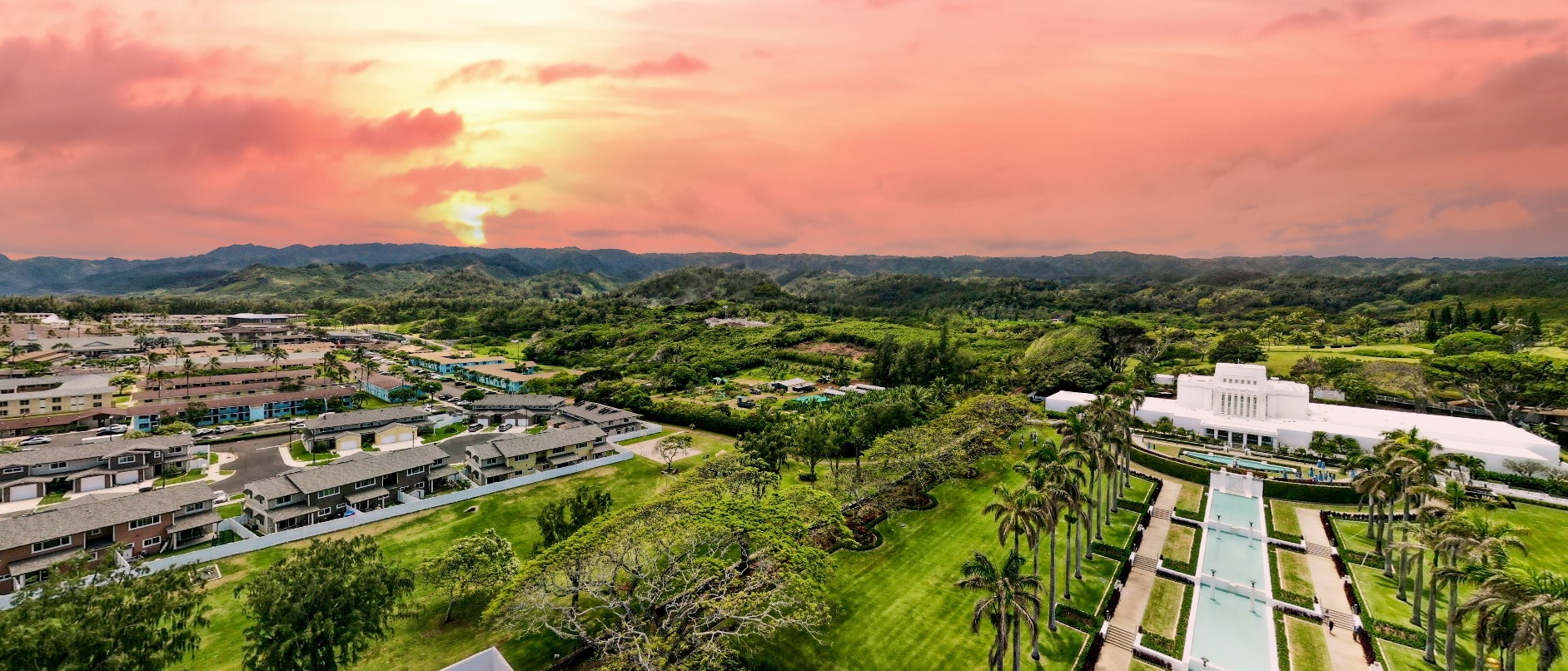
The Laie Hawaii Temple, a significant landmark in the Pacific islands, stands as a testament to faith and dedication. Its announcement was made on October 3, 1915, and the groundbreaking ceremony took place shortly thereafter, on February 8, 1916. As the fifth temple in operation for The Church of Jesus Christ of Latter-day Saints, its historical and spiritual importance is profound.
Located on a picturesque site encompassing 11.4 acres, the temple is not just a spiritual haven but also a visual masterpiece. The exterior is unique, crafted from concrete mixed with crushed lava and coral, reinforced with steel. This combination produces a striking white cream finish that beautifully blends with the lush Hawaiian landscape. The temple is designed with architectural features including a single attached central tower topped with a flat roof.
Inside, the Laie Hawaii Temple boasts a total area of 42,100 square feet, making it the smallest temple ever constructed by the Church at just 10,500 square feet upon its completion. Although modest in size, it houses four instruction rooms (following a four-stage progressive format), five sealing rooms, and a baptistry—facilities that support a variety of sacred ordinances.
The dedication of the site was performed by President Joseph F. Smith on June 1, 1915, marking the beginning of a spiritual journey that culminated in the temple’s open house from November 27 to 30, 1919, presided over by Heber J. Grant. The temple underwent renovations and rededication ceremonies in the late 1970s, notably opening to the public again in May 1978 and being rededicated by Spencer W. Kimball from June 13 to 15 that same year. More recently, a public open house was held from October 22 to November 13, 2010, leading to a final rededication by Thomas S. Monson on November 21, 2010.
Surrounded by tropical gardens and cascading pools, the Laie Hawaii Temple is set on a gently rising hill just half a mile from the Pacific Ocean. Access to the temple is facilitated by Hale Laa Boulevard, an exquisite road flanked by palm trees and decorative lights, creating a welcoming atmosphere. The visitors’ center on the temple grounds attracts many, while down the road lies Brigham Young University–Hawaii and the renowned Polynesian Cultural Center.
The Laie Hawaii Temple holds a unique historical significance as the first temple built in the Hawaii Territory and in the Pacific islands, making it a pioneering structure dedicated outside the continental United States. The temple is situated on the original landholdings known as Laie Plantation, a 6,000-acre parcel bought in 1865 for $14,000. Its adjacency to Brigham Young University–Hawaii further emphasizes its role as a spiritual and educational hub.
Artistic elements enhance its exterior, with carved friezes designed by sculptor Avard Fairbanks. These friezes represent the four dispensations of time: the Old Testament (west), New Testament (south), Book of Mormon (north), and Latter-day Dispensation (east).
The story of the temple’s construction is interwoven with moments of divine intervention. For instance, work halted due to a shortage of lumber, prompting prayers from the builders. Miraculously, within two days, a stranded freighter offered its entire cargo of lumber, ensuring the completion of the temple.
In 1976, the temple closed for two years to undergo extensive renovations that enhanced its patron and administrative facilities. It adjusted the ordinance rooms to include stationary rooms designed for a motion-picture presentation of the endowment. Again closing in December 2008 for structural upgrades and restoration, the temple aimed to return to its original progressive-style endowment presentation, albeit using video technology. The baptistry also received repairs and renovations during this time.
The Laie Hawaii Temple is not only a symbol of spiritual commitment but also a rich tapestry of history, culture, and community, making it an essential destination for visitors and faithful alike.